
The Shift in Traditional SEO: Why Google Traffic Is Changing
Learn how AI Overviews, zero-click search, and AI assistants are changing organic traffic, and why Shopify merchants need to expand SEO with AI visibility, product data, and measurement.
Download the Complete AI Visibility White Paper
Get the full AI Visibility playbook as a beautifully formatted PDF. Perfect for sharing with your team or reading offline.
The foundational principle of the commercial web is changing. For two decades, creators and businesses produced useful content, search engines indexed it, and qualified traffic came back through blue links. That exchange still matters, but AI Overviews, answer engines, and zero-click search are changing how much traffic reaches the source page.
This is not a reason to abandon SEO. It is a reason to stop treating rankings as the only scoreboard. Shopify merchants now need a wider visibility model: search rankings, AI mentions, AI referrals, product feed readiness, schema quality, buyer-question content, and revenue attribution.
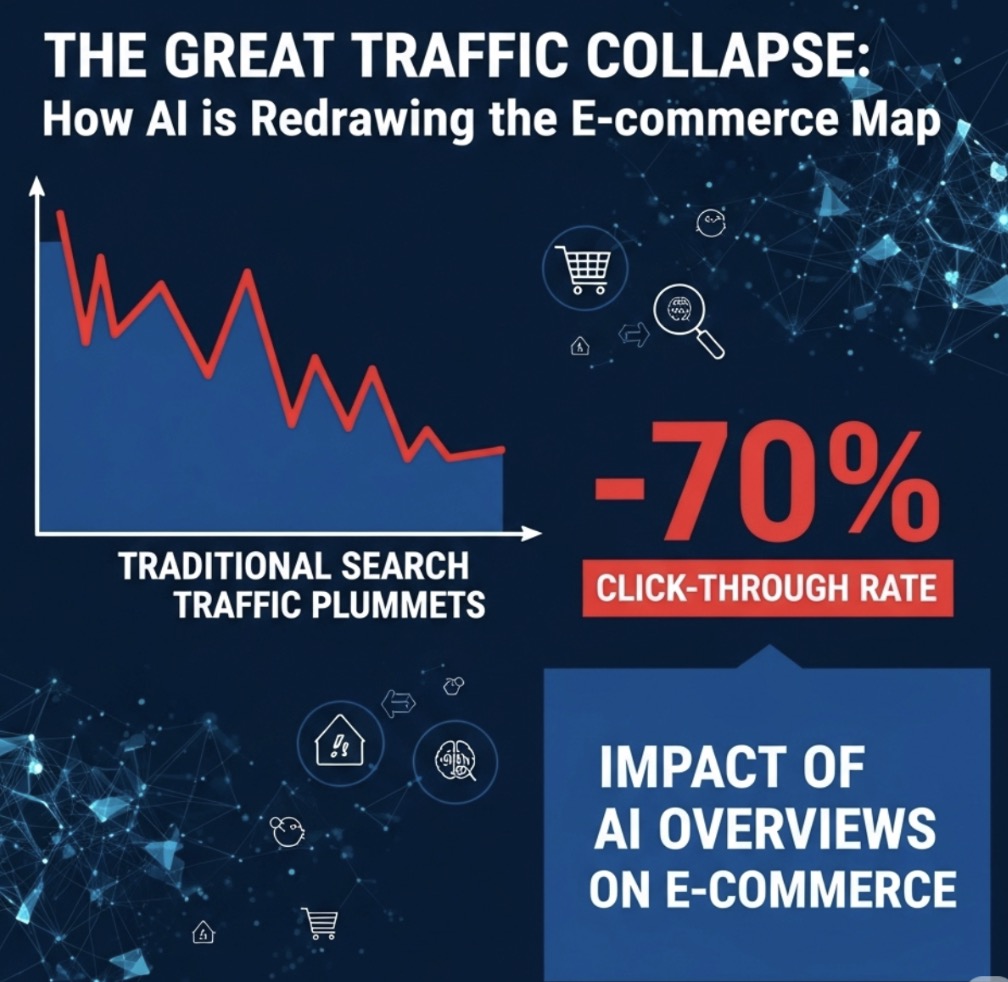
The Rise of the Zero-Click SERP
The primary symptom of this collapse is the rise of the “zero-click” search engine results page (SERP). For years, the goal of Search Engine Optimization (SEO) was to secure a high-ranking position that would entice a user to click through to a brand’s website. That click was the currency of the digital economy. Today, that currency has been devalued to the point of irrelevance. A majority of searches conducted on dominant platforms like Google no longer result in a click to an external website. This is not an anomaly; it is the new default user behavior.
Data from across the industry paints a stark and undeniable picture:
- In 2024, studies revealed that nearly 60% of all Google searches in the United States concluded without a single click to an organic or paid result
- Globally, this figure climbed to 65% and is projected to exceed a staggering 70% by 2025
- On mobile devices, where screen real estate is at a premium and immediacy is paramount, over 75% of Google searches now result in zero-click outcomes
This phenomenon is the result of a deliberate, long-term strategy by search engines to transform their results pages from a directory of links into a destination in and of itself. Through features like knowledge panels, direct answers, and featured snippets, search engines have systematically trained users to expect answers directly on the SERP, obviating the need to visit the source websites that provide the underlying information.
What was once a gateway to the broader web has become a walled garden, and the walls are getting higher every day.
The AI Overview Effect: Clicks in Freefall
If the zero-click SERP was the initial shock to the system, the widespread rollout of Google’s AI Overviews is the aftershock that is leveling what remains of the old structure. Introduced in 2024, this feature uses generative AI to synthesize information from multiple web sources into a single, comprehensive summary displayed at the very top of the search results. While positioned as a user-centric innovation, its impact on publisher and e-commerce traffic has been nothing short of catastrophic.
Multiple independent studies have quantified the devastating effect on click-through rates (CTR):
- The presence of an AI Overview causes the CTR for the number one organic position to plummet by 32% to 34.5%
- Mail Online revealed an even more dramatic decline: a 56.1% drop in desktop CTR and a 48.2% drop on mobile, even when their site held the top organic rank
- Across the top five organic positions, the average CTR decline is nearly 18%
Perhaps more alarming is the user behavior associated with the AI-generated summaries themselves. The summaries often contain links to the sources from which the information was synthesized, a feature Google points to as evidence of its continued commitment to the web ecosystem. However, user data tells a different story:
- Users click on a link embedded within an AI summary in a mere 1% of visits
- Users are significantly more likely to end their search session entirely after viewing an AI Overview (26% of the time) compared to a traditional SERP (16% of the time)
This indicates that the AI-generated answer is often perceived as “good enough,” terminating the user’s journey of discovery.
The Asymmetry of Consumption vs. Referral
To fully grasp the magnitude of this economic shift, one must look beyond clicks and examine the underlying behavior of the new agents shaping the web: AI crawlers. These are the automated bots sent out by companies like OpenAI, Anthropic, and Google to gather the data needed to train their large language models (LLMs). Their behavior reveals the new, deeply asymmetrical relationship between content creators and AI platforms.
A useful metric to understand this asymmetry is the “crawl-to-referral ratio”—the number of pages a bot consumes from a website for every one visitor it sends back:
- Googlebot: Might fetch around 18 HTML pages for every referral click it delivers (a reasonable exchange)
- OpenAI’s GPTBot: Consumes, on average, 1,500 pages for every single referral it sends
- Anthropic’s ClaudeBot: Even more voracious, consuming an incredible 60,000 pages per referral
This is not a partnership; it is a data mining operation on an industrial scale. The old model valued a website for its ability to attract and convert human traffic. The new model values a website as a raw data source, a quarry to be mined for the linguistic and factual material needed to build a competing intelligence.
What This Means for Your Business
This dynamic creates a lose-lose scenario for content creators and businesses:
- Your content is used to train and populate AI summaries
- You receive neither the click nor the credit
- The value you create is extracted and repurposed while the traffic you depend on evaporates
The impact is not uniform across all query types. To date, informational queries—those seeking answers to questions like “what is,” “how to,” or “why”—have been the most severely affected, with data showing that 88% of all AI Overviews are triggered by such searches.
Transactional and e-commerce queries have, for now, been less impacted. This is a critical distinction and a point of dangerous complacency for many online retailers. The technology is being perfected on informational content, but its eventual, inevitable application to commercial queries is not a matter of if, but when.
The End of SEO As a Click-Only Model
The economic incentive that fueled the creation of the rich, diverse, and high-quality content that powered the web for two decades is under pressure. But the practical response is not to declare SEO dead. Google’s own AI Search guidance still points back to searchable, crawlable, useful pages as the foundation.
Traditional SEO tactics—keyword research, technical crawlability, internal links, structured data, and content marketing—still matter. What has changed is the path from discovery to purchase. AI systems consume and summarize content, sometimes with links and sometimes without clear attribution. A merchant needs to be understandable inside that system and measurable when traffic or orders arrive.
The question is no longer only how to rank higher on Google. The question is how to make your store easy to find, easy to understand, easy to cite, and easy to buy from across search, AI assistants, and agentic shopping surfaces.
This is part 1 of our 7-part series on AI Visibility and the future of e-commerce. In the next article, we’ll explore how Gen Z is abandoning Google for TikTok, Reddit, and ChatGPT—and what that means for your marketing strategy.
Ready to learn more? Download the complete AI Visibility white paper for the full playbook on surviving and thriving in the post-search era.
Related Articles
Does Google Penalize AI-Written Content? What to Know
Discover what Google's search and spam policies actually state about AI-written content, originality, and how to optimize your Shopify store safely.
 Alex
Alex Shopify Blog Not Indexed? Find the Actual Cause
Diagnose Shopify blog indexing with URL Inspection, publication status, canonical tags, internal links, and the exact Search Console reason.
Alex GEO vs SEO vs AEO for Ecommerce: What Shopify Teams Need to Know
Understand the differences between SEO, AEO, and GEO for ecommerce, and learn how Shopify merchants can build a practical AI visibility workflow.
 Vincent