
AI Visibility: The Framework Expanding SEO in the Age of ChatGPT
Learn why GEO, AEO, and LLMO are best treated as part of a broader AI visibility workflow for ecommerce: crawlability, schema, llms.txt, product data, trust signals, and buyer-focused content.
Download the Complete AI Visibility White Paper
Get the full AI Visibility playbook as a beautifully formatted PDF. Perfect for sharing with your team or reading offline.
AI-driven discovery demands more than keyword pages and blue-link rankings. It also requires product data, answer-ready content, crawl access, structured facts, and a way to measure whether AI assistants are actually sending useful shoppers.
That does not mean SEO is dead. Google’s own guidance now frames optimization for generative AI experiences as part of optimizing for Search. AI Visibility is best understood as the practical layer that expands SEO for a world where shoppers ask ChatGPT, Gemini, Perplexity, and AI-powered search systems for answers, comparisons, and product recommendations.
The digital marketing industry is still full of acronyms: GEO, AEO, LLMO, AIO. The useful move is not to chase every label. The useful move is to build one workflow that makes a store easy to crawl, easy to understand, easy to trust, and easy to recommend.
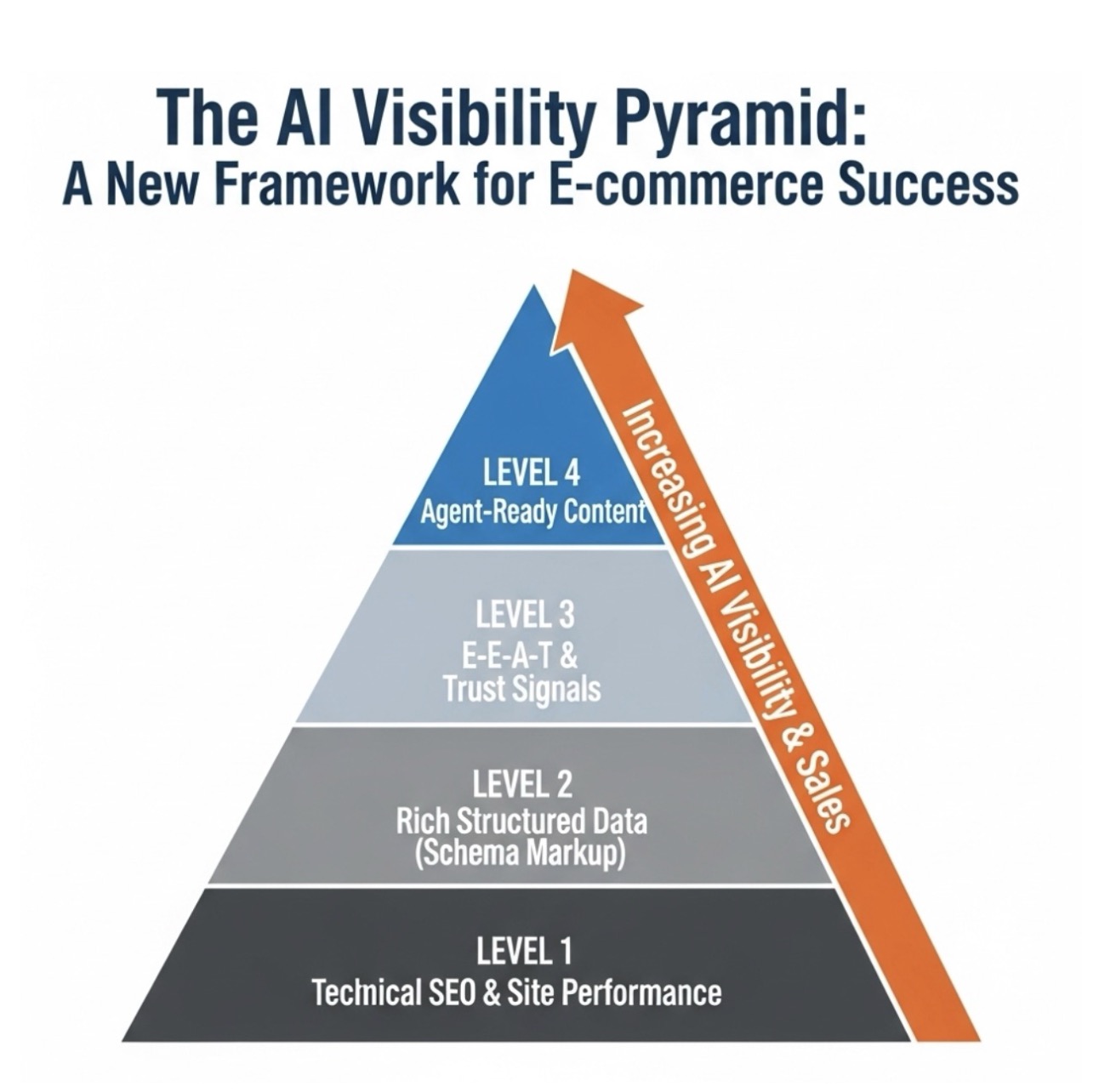
The Alphabet Soup Problem
The recent explosion of interest in optimizing for AI has led to a proliferation of new, often overlapping and poorly defined terms. Practitioners and vendors are rushing to claim thought leadership by coining acronyms like AIO, GEO, AEO, and LLMO. While born from a genuine need to describe new optimization activities, this chaotic terminology creates confusion and encourages a tactical, siloed approach where a holistic strategy is required.
Deconstructing the Acronyms
The current landscape includes:
- GEO (Generative Engine Optimization): Optimizing content to be included in the outputs of generative AI models like ChatGPT or Google’s AI Overviews
- AEO (Answer Engine Optimization): Focusing on optimizing content to appear in direct answer boxes and voice search results
- LLMO (Large Language Model Optimization): Making content more “friendly” to large language models
- AIO (Artificial Intelligence Optimization): A broad, ambiguous term for any AI-related optimization activity
The common flaw in all these frameworks is their tactical and reactive nature. They are extensions of the old SEO mindset, focused on optimizing for a specific output—an AI-generated answer, a featured snippet, a chatbot citation. They fail to address the underlying strategic imperative, which is to influence the AI’s entire knowledge base and evaluation process.
Introducing AI Visibility
We propose a more comprehensive and practical framework: AI Visibility.
AI Visibility is the function concerned with ensuring a brand’s products, data, and narrative are accurately represented and fairly considered by AI-assisted discovery systems. This includes, but is not limited to:
- Generative search engines
- Conversational chatbots
- Voice assistants
- Visual search tools
- Emerging autonomous AI agents
AI Visibility is not a set of tactics; it is a core business function that integrates:
1. Technical Optimization
Ensuring a website is perfectly structured for machine consumption through:
- Clean, semantic HTML code
- Robust schema markup
- Clear AI-specific directives
- Proper crawler management
2. Content Strategy
Creating authoritative, trustworthy, and experience-driven content that serves as a reliable source of truth for AI models:
- Complete answers to user questions
- Demonstrable expertise and experience
- Clear, unambiguous information
- Multi-format content (text, images, data)
3. Data Integrity
Maintaining the accuracy and consistency of all product and brand information across all digital touchpoints to build the AI’s confidence in your brand as a reliable entity:
- Consistent pricing and availability
- Accurate product specifications
- Up-to-date contact information
- Verified reviews and ratings
The Technical Blueprint: robots.txt and llms.txt
The foundation of any successful AI Visibility strategy is a sound technical blueprint. This involves providing clear, unambiguous instructions to the various automated agents that visit your website.
robots.txt: The First Line of Defense and Welcome Mat
The robots.txt file remains the universal standard for communicating with web crawlers. In the AI era, its role has become even more critical. A modern robots.txt file must be configured with AI-specific directives:
# Traditional search engine crawlers
User-agent: Googlebot
Allow: /

# AI training crawlers
User-agent: GPTBot
Allow: /
Crawl-delay: 1

User-agent: ClaudeBot
Allow: /
Crawl-delay: 2

# AI live retrieval crawlers
User-agent: OAI-SearchBot
Allow: /

User-agent: ChatGPT-User
Allow: /
This granular control allows a site owner to welcome the crawlers that power valuable live-retrieval features while potentially limiting access for crawlers used purely for model training.
llms.txt: The Proactive Playbook for AI
While robots.txt is a set of “do’s and don’ts,” the llms.txt file is an emerging standard that acts as a proactive, curated guide for AI systems. It is a simple text file, written in Markdown format, placed at the root of a domain. Its purpose is to provide a “smart sitemap” specifically for LLMs.
An example llms.txt structure:
# YourStore.com

## About

We are the leading provider of eco-friendly running gear...

## Key Resources

- Product Catalog: /products
- Shipping Policy: /policies/shipping
- Return Policy: /policies/returns
- Size Guide: /guides/sizing
- Customer Reviews: /reviews

## API Documentation

- Product API: /api/docs/products
- Inventory API: /api/docs/inventory
The Great llms.txt Debate
The emergence of llms.txt has not been without controversy. Google has said that llms.txt does not receive special treatment in Google Search, and Google’s latest AI Search guidance points merchants back to the fundamentals: crawlable pages, useful content, clear structure, snippets that can be shown, and accurate product or business data.
That makes the honest framing important. llms.txt should not be sold as a Google AI Overview ranking switch. It is better understood as a curated store map for AI systems and future AI agents: a concise file that points to the pages, products, policies, and guides that matter most.
The decision to implement llms.txt is strategic because AI discovery is not only Google. Shopify merchants should still maintain strong pages, schema, feeds, and buyer-focused content. llms.txt complements that foundation; it does not replace it.
The Layered Stack of AI Visibility
To clarify the roles of different technical files, view them as a layered stack:
| File | Purpose | Target Audience | Key Function |
|---|---|---|---|
| robots.txt | Access Control | All Crawlers | ”Gatekeeper”: Sets rules on what can/cannot be crawled |
| sitemap.xml | Discovery | Search Engines | ”Map”: Provides a comprehensive list of all URLs |
| Schema.org | Understanding | All Machines | ”Translator”: Explains what content means |
| llms.txt | Prioritization | AI/LLM Systems | ”Curated Guide”: Highlights important content |
Moving from Tactics to Strategy
The proliferation of terms like GEO and LLMO is a symptom of the industry’s attempt to describe a real change. The risk is turning that change into a collection of hacks: special files, artificial long-tail pages, fake mentions, or thin content written only for AI.
AI Visibility, in contrast, is a durable workflow. The goal is not to “trick” an algorithm into citing your content for a single query. The goal is to make your products and expertise clear enough that search engines, answer engines, and AI shopping systems can understand them accurately.
This reframing elevates the conversation from short-term tactics to long-term strategy, positioning those who adopt it as strategic partners in the new digital economy, not just SEO technicians.
The Path Forward
Success in the AI era requires:
- Abandoning the acronym chase: Stop treating GEO, AEO, or LLMO as separate hacks
- Embracing comprehensive visibility: Think holistically about how AI systems discover, understand, and trust your content
- Investing in technical infrastructure: Implement proper robots.txt, schema markup, and llms.txt
- Building for multiple AI platforms: Don’t just optimize for Google—prepare for ChatGPT, Claude, Perplexity, and others
- Focusing on trust and authority: E-E-A-T principles matter more than ever
The age of simple keyword pages is fading. The age of AI Visibility has begun. Shopify merchants still need SEO, but they also need product data, answer-ready content, structured context, crawler access, and measurement. Those pieces work together.
This is part 5 of our 7-part series on AI Visibility and the future of e-commerce. In the next article, we’ll explore the specific challenges Shopify merchants face and how to overcome them.
Ready to implement AI Visibility? Download the complete AI Visibility white paper for detailed strategies and implementation guides. Or get started today with our automated AI Visibility solutions.
Related Articles
Shopify's Own Data Says AI Shoppers Convert 50% Higher. Here's How to Make Sure AI Can Actually Find Your Store
Shopify's Q1 2026 data shows AI-referred shoppers convert nearly 50% higher and spend 14% more. But AI only recommends stores it can crawl, read, and trust. Here is the free GEO self-check every Shopify store should run first.
 Alex
Alex What Is llms.txt? Shopify Guide for 2026
A complete guide to llms.txt for Shopify merchants: what it is, why it exists, what goes inside it, which AI engines use it, and how to create one.
Alex Shopify robots.txt for AI Crawlers: A Practical Visibility Checklist
Learn how Shopify merchants should think about robots.txt, GPTBot, ChatGPT-User, ClaudeBot, PerplexityBot, GoogleExtended, and AI crawler access for better AI visibility.
 Vincent